Skip to content Skip to left sidebar Skip to right sidebar Skip to footer

Towards Restoring a Caerleon Station


15/08/2026

TRACS featured in Professor Mark Barry’s blog

TRACS has worked with Professor Mark Barry as part of our strategy and it was really pleasing to see his latest blog (full link below) where he has questioned some of the expenditure on proposed projects for railways in South Wales. As you can see his view is that Caerleon station should be pursued before other projects.

“Do we need a £60-80M Metro rail extension to Abertillery”

Maybe both the above schemes are cooked in. However, there is another upcoming scheme that we also need to interrogate. There is a long-standing desire to reconnect Abertillery with a short ~4km reopening and connection from the existing Ebbw Valley line at Aberbeeg. This would be linked and part of a bigger scheme (circa £100m) to secure 4tph on the Ebbw Valley line (with 2tph to Ebbw Vale and 2tph to Abertillery).

Yes, I like the scheme. However, this provides an example in CCR that ought to be influenced by limits on capital funding and an honest appraisal of where costs and benefits fall. The stark reality is that most of the benefits of the scheme are associated with securing 4tph on the existing line south of Llanhilleth, and most of the capital costs to extend the line to Abertillery. A 4tph provision on the existing line could be achieved at much lower cost with a turn back at Llanhilleth (only a single track to Ebbw Vale and new road at Cwm has constrained a doubling) and instead serve Abertillery with a more cost effective regular frequent integrated bus service, probably operating from Brynmawr (as part of bus franchising).

In fact even with a higher capex, the longer term Radyr-Coryton connection (and there are several variants) on the Metro will deliver far more regional benefits given the higher number of Origin and Destination points connected by the link vs the Abertillery extension.

Instead, the capital funds could deliver more benefit by enhancing the Marches line to Abergavenny (including a turn back at Abergavenny) to enable local Metro services of at least 2tph (which it currently does not have) operating via Newport from the Ebbw Valley and perhaps one or two additional stations, including Caerleon. This would have the additional benefit of removing some of the local stops from the long-distance Manchester and North Wales services so reducing their journey times.

If the Wales Rail Board is effective it will surely come to the same conclusion.

https://swalesmetroprof.blog/2026/08/09/caerphilly-station-tenby-abertillery-extension-are-these-the-best-vfm-schemes/


Drawing competition: My picture of Caerleon station


TRACS AGM: Tuesday 30 June 2026

Dear Supporter,

You are invited to attend the TRACS AGM to be held in St Cadoc’s Church on Tuesday 30th June 2026.

Venue: St Cadoc’s Church

Date: 30th June 2026

Time: 19:00-20:00

Agenda

  1. Review of Milestones over the last year
  2. Election of Officers
  3. Treasurer’s Report
  4. Questions from the floor
  5. Plans for the coming year
  6. Any other business

About TRACS


We are a group campaigning for a train station in Caerleon, South Wales. Our mission is to gain community and political support for reopening a railway station in Caerleon, providing access to the national rail network and promoting sustainable transport.

The station would be easily accessible to most of Caerleon’s population, support heritage tourism by connecting visitors to Roman sites, stimulate economic growth through increased foot traffic and business opportunities, and help alleviate local traffic congestion while improving air quality.

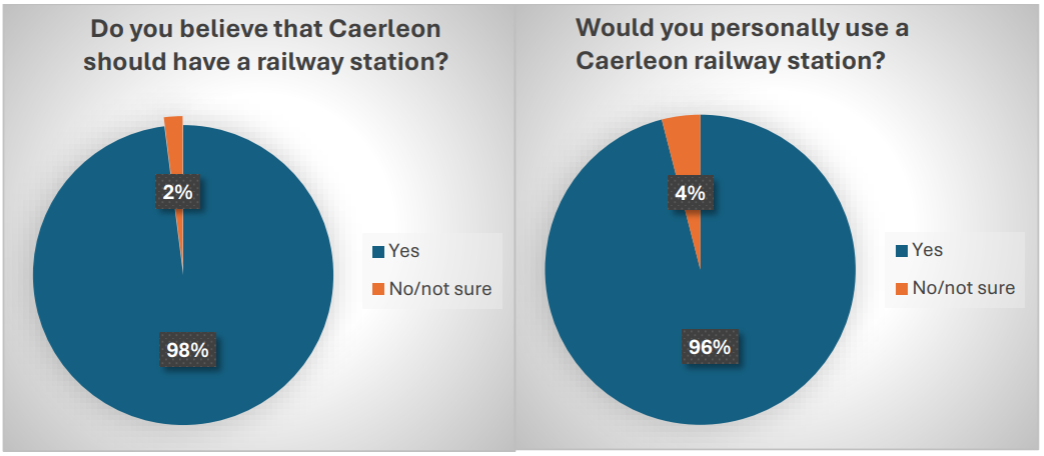
A 2025 survey of 1,920 local residents by the rail group Towards Restoring a Caerleon Station (TRACS) showed overwhelming support and clear patterns of intended use for a reopened Caerleon station. 98 percent of respondents believed Caerleon should have a railway station and 96% stated they would personally use it if reopened.
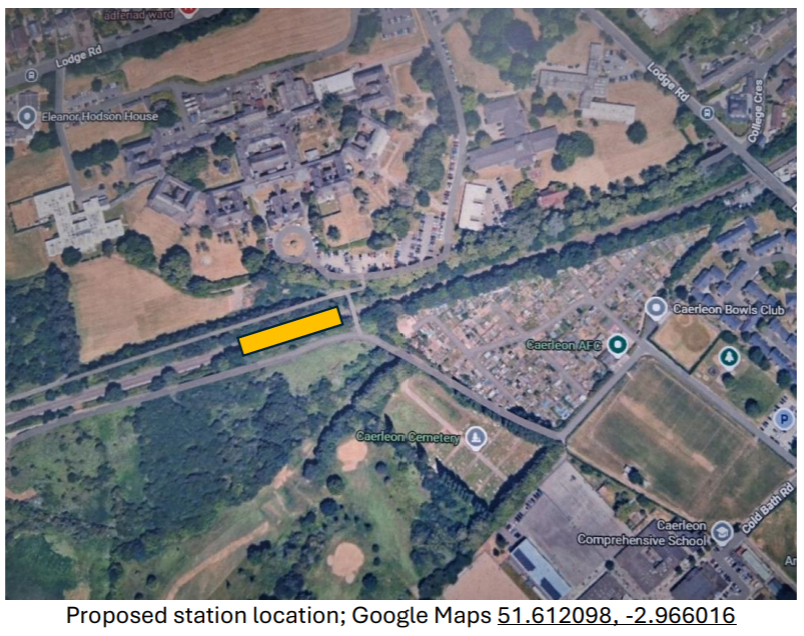
The preferred station site lies immediately south of St Cadoc’s Hospital.

The scheme involves two 125-metre platforms suitable for five-car trains on a straight, plain-line track with compliant gradients, supported by modern signalling already compatible with station provision, an existing footbridge installed in 2011 that enables step-free access and active travel integration, and no known historic structures that would impede construction – together indicating high deliverability and comparatively low engineering risk.
Find out more